
There are many types of LED headlight bulbs, including the familiar H1, H3, H4, H7, H8, H9, H11, 9005, and 9006. The choice of LED headlight bulb model depends on the vehicle’s configuration and the driver’s needs, and each model has specific applications and advantages.
Whether you’re an individual car owner looking to upgrade your vehicle lighting or a brand or retailer entering the automotive lighting industry, a thorough understanding of LED headlight bulb models and their application characteristics is crucial for successful product selection or development.
Why Should Cars Upgrade to LED Headlights?

Many car owners are dissatisfied with their headlights, primarily due to age and insufficient brightness. This often necessitates a headlight modification.
Heavy-duty trucks, in particular, are often driven for extended periods at night. More and more car owners are opting for headlight modifications out of concern for nighttime safety.
Headlight modification is becoming increasingly simple, requiring only a simple replacement of the headlight assembly or fog lamp assembly. Standard installation and connectors are standard, significantly promoting the adoption of LED headlights.
What Are LED Headlight Bulbs?
An LED (light-emitting diode) is a component made of semiconductor material that converts electrical energy directly into light.
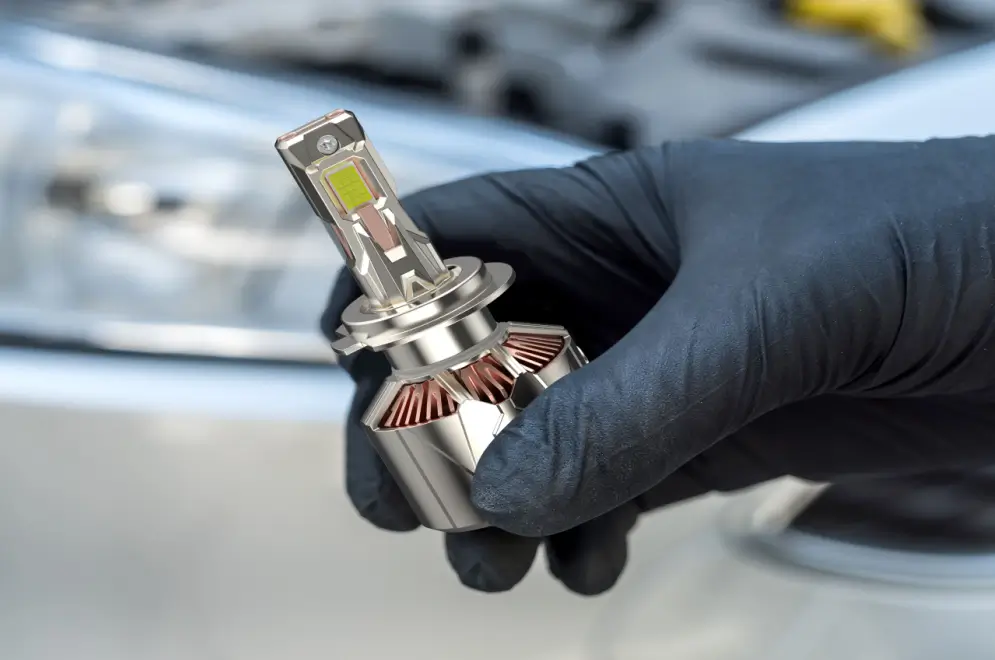
Depending on the different semiconductor materials, when an electric current passes through them, the lamp beads can emit different colors of light, and the light emitted by the LED headlights can also change accordingly.
This direct conversion of electricity into light is how LEDs work.
Features: LED headlight offers the same exceptional brightness as xenon lamps and offers a lifespan far exceeding that of halogen and xenon headlights.
LED headlights are increasingly being equipped on a growing number of car models due to their fast lighting, energy-saving, and environmentally friendly features, as well as their low cost and low voltage, which provides greater safety. LED headlight bulbs are smaller in size, leaving more design space for the front and rear of the vehicle.
Four Important Components of LED Headlight Bulbs
LED Beads:
An LED bead, also known as the LED chip, is the core light-emitting component of LED headlights. It stabilizes the current and voltage for the headlight bulb, and the performance of the LED chip directly impacts the brightness, color temperature, and lifespan of the headlight.
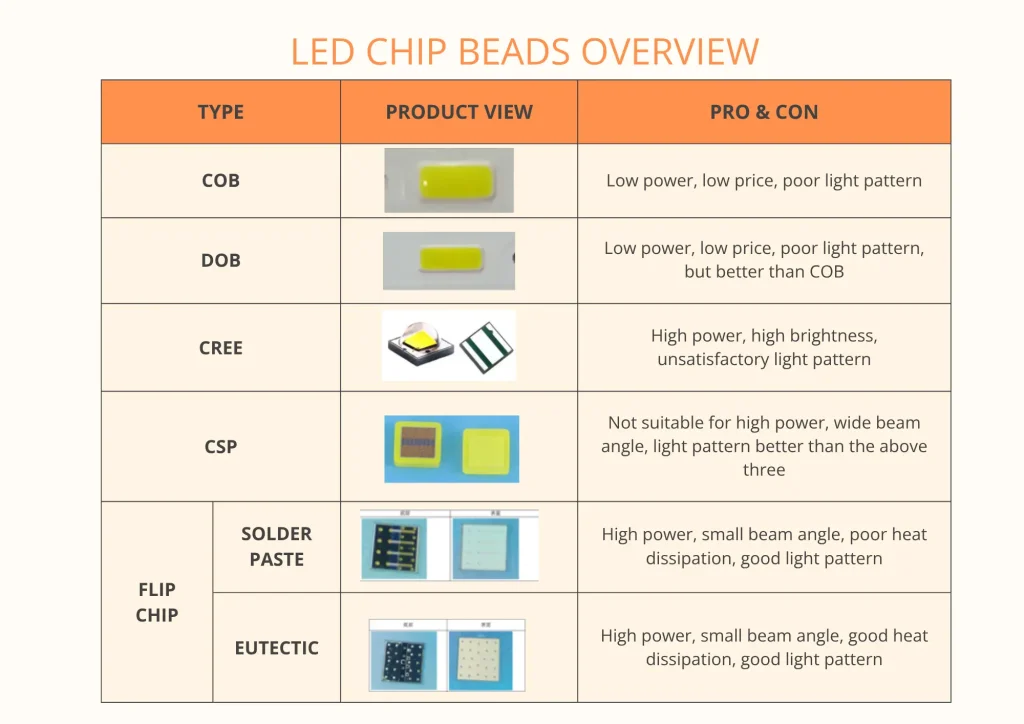
Common chip types include COB, CSP, ZES, and flip-chip. Currently, AKE LED Headlight Factory’s LED headlight bulb chips all utilize a high-brightness flip-chip eutectic process.
LED Driver:
The driver primarily converts the car battery voltage into a stable current suitable for the LED, preventing voltage fluctuations from damaging the bead and providing power to the LED.
LED headlights utilize either an external or integrated driver design and are typically equipped with waterproof and shockproof features to prevent fluctuations in temperature and performance that can affect the LED.
Aluminum:
Aluminum components generally refer to the aluminum substrate or aluminum extrusion that heats the LED.
AKE’s LED headlight aluminum components are made of 6063 Aircraft aluminum, which offers excellent thermal conductivity, preventing overheating, ensuring bulb operation, and extending the lifespan of the LED headlight.
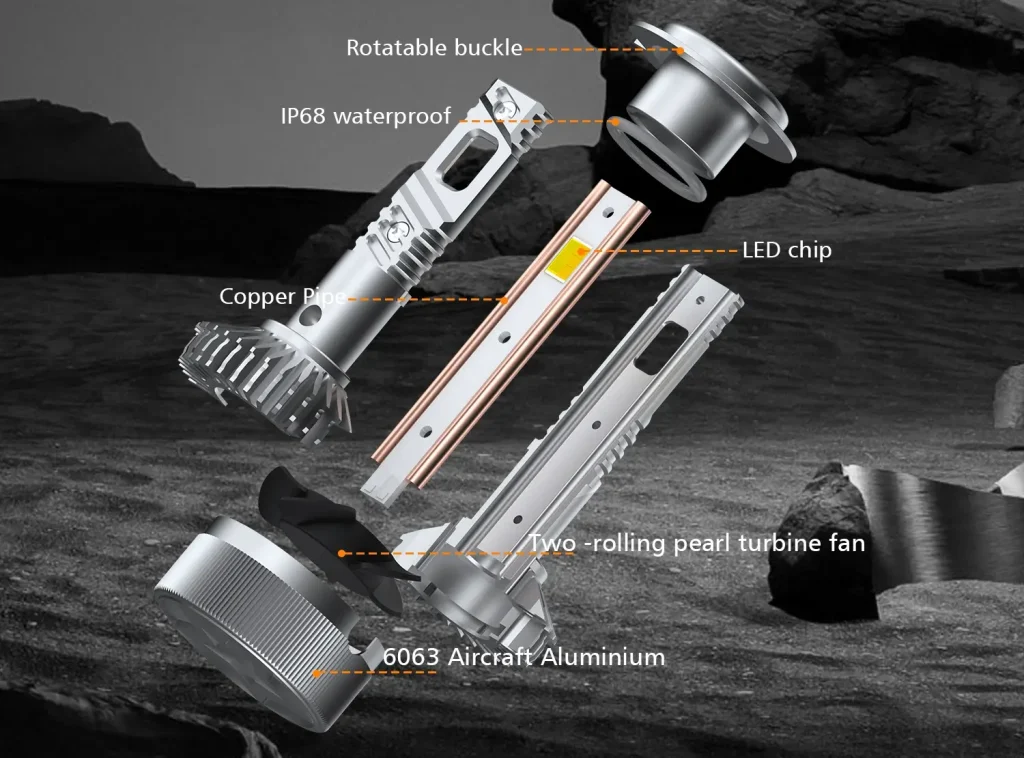
Current aluminum substrates undergo an oxidation treatment to enhance corrosion resistance and strength, serving as the core heat dissipation mechanism for LED headlights.
Wires:
Wires connect various circuit components and carry current. The high-quality Teflon wire we use not only ensures stable current transmission but also withstands the high temperatures, vibrations, and friction of the automotive environment, ensuring a secure power supply to the lamps.
Car LED Headlight Bulbs Comparison Guide
On some social media, like Facebook, Reddit, I saw some people complaining about the headlights in some cars and how bad they are. Especially if you’re out in the country driving at night, there are lots of animals hiding away that you can’t see.
So today I want to show you what types of different headlight technology there are on the market.
We’ll compare each of them, figure out the pros and cons, and then find out which you should be picking for your next new headlight.
Halogen v HID v LED v Laser:
Headlights tested, compared, and explained! Should you upgrade to LED?
| Features | LED Headlight Bulbs | Halogen Bulbs | HID (Xenon) Bulbs | Laser Bulbs |
| Brightness | 3,000–6,000lm | 1,000–1,500lm | 3,000–5,000lm | 6000+ lm |
| Lifespan | Long (10,000–30,000 hrs) | Short (500–1,000 hrs) | Medium (2,000–5,000 hrs) | 10,000-20,000hrs |
| Installation | Moderate (may require kit or professional installation) | Easiest (direct replacement) | Complex (requires ballast/kit) | Very complex (retrofit only/professional install) |
| Color Temperature | 5000K–6500K (cool white) | 3200K (warm yellow) | 4300k-6000k | Ultra white/light blue (6,000K+) |
| Warm-Up Time | Instant | 1s | 1s-2s | Instant |
| Cost | Mid to High | Low | Mid | Extremely High (luxury only) |
Halogen
This is the type of light I don’t really like on cars, and it’s often at the lower end of the car range.
So, halogen, what is that?

A halogen is kind of like an incandescent light, those lights you used to have in your house years and years ago. It’s very old-school technology. You have a filament that sits inside a halogen gas, then it has a current pass through it, and that causes it to emit light.
Get the light out onto the road, you can often tell a car has halogen lights, because of that yellowish color, it’s not a very bright light, and it’s not the best light to have if you are doing a lot of country driving or driving in dark environments.
Now, what are the pros of this?
The pros are that it’s very cheap to replace and they’re easy to come by. As well, so doing this yourself isn’t too hard.
The con, on the other hand, is that it’s inefficient compared to an LED headlight.
So you will use a little bit more fuel to run that light, and on top of that, it doesn’t last very long. These have to be replaced a whole lot more often than LED headlights.
HID
Back in the early 2000s, LED headlight bulbs didn’t even exist. But then came the HID conversion kit. Now, this modification isn’t legal for street use, but that doesn’t stop people from using it in all kinds of applications.
The cool thing about HID is that it comes in multiple power levels and multiple colors.

You can go from 3000K, which is more of a golden yellow color, to 4,000K, which is more of a halogen-like color; to 5,000K, which is more of a pure white color; to 6,000K, which is white with a little more modern hue of blue in it. 8,000K, which is a lot more blue, 10,000K, which is completely blue, or even 12,000K in some applications for a purple look.
You can also get custom colors and pink and orange, and green. They’re not very bright, but you’ve got a ton of different color options with HID. But over the years, advancements in technology with LED bulbs started, and people desired all those different colors less and less, and the LED bulb is now king.
LED Headlight
It’s a light-emitting diode. This technology has been around for donkey years. It’s effectively a semiconductor that emits light when a current passes.
When it comes to cars, though, you have LEDs that sit on their own or within a cluster, and then you’ve got this type, which is an LED headlight with a projector lens. The LED headlight then goes through the projector lens and gets shot out onto the road.
Now, the pros of this system are that it’s about 10 times more efficient than a halogen headlight. That means over the life of the car, it’s going to save you a few bucks. Because it doesn’t have to work as hard to run.

The LED headlight, and on top of that, it also runs much cooler. I can have my hand here in front of it, and it’s nowhere near as warm as a halogen headlight. But the con it’s harder for a consumer to replace.
Laser Headlight
Okay, let’s talk laser headlight. This is space-age technology, and I love where we’re heading with this.
What is laser headlight technology?

They basically have three blue lasers that go through a set of mirrors they’re. Then fired through a lens that has yellow phosphorus in it that reacts.
It emits a white light that is 10 times brighter than LED headlights, so that’s too bright to have out onto the road. And they put it through a diffuser, which dims it down a little bit. But the result is lighting that allows you to see 600 meters.
Ahead of the car, which is pretty insane, but that doesn’t work at city speeds. So, during city speed, this is just regular matrix-led lighting. While that headlight’s on, it’s only when the car gets to 60 kilometers an hour. So this is the future of headlight technology
The pros it’s 30% more efficient than LED headlights’ lighting technology. And of course, you can see 600 meters ahead of the car, but the con is very expensive technology, which is why you only really see it on more expensive production cars. It also means if you do have a minor car accident, this whole module here is going to cost you a fortune to fix.
Why Are LED Headlights Legal?
I’m seeing this question more and more often online about why LED headlights are legal. Regarding the legality of LED headlights, there are two scenarios.
First, if your vehicle was factory-installed with LED headlight bulbs, then it is legal. Second, if it is a retrofit, regulations for the use of LED headlights on vehicles vary across different countries and regions.
If the LED headlight bulbs you purchase lack relevant certifications, such as DOT or ECE, you may be breaking the law. The beam produced by uncertified LED headlight bulbs can dazzle oncoming drivers and endanger road safety.
If you plan to replace halogen or HID headlights with LED bulbs, please ensure that they comply with the following common regulations:

How to Stay LED Legal and Safe?
Local Market Regulations:
The US Department of Transportation (DOT) requires complete headlamp assemblies (not individual bulbs) to be certified, and LED headlights must be properly aimed and not dazzle oncoming drivers.
In Europe, under ECE regulations, LED bulbs must be ECE certified for use in specific housings. Similar regulations apply in Canada and other regions.
Brightness:
Headlight brightness is limited to between 1500 and 2000 lumens in most countries and regions. In Europe, headlight output is limited to between 900 and 2000 lumens, depending on vehicle type and headlight class.
Color Temperature:
Color temperature typically ranges from 3,000K to 6,000K (white or selective yellow). Light that is too bluish or too warm a yellow can be distracting and pose a safety hazard.
How to Choose Quality LED Headlight Bulbs?
Not all LED headlight bulbs are created equal. Choosing the wrong type can lead to poor visibility, compatibility issues, and wasted money, and it can also significantly impact driver safety.
When choosing the right LED headlight bulb, you need to consider four key factors: socket type, color temperature, CANbus compatibility, and cooling design.
Check The Correct Bulb Size And Socket Type.
Each vehicle uses specific headlight bulb sizes. Common types include H11, H4, H7, 9005, 9006, 9012, and H13. You can find the correct size in your vehicle’s manual or by using the online tools provided by most LED manufacturers.
Choosing the wrong socket may cause the bulb to loosen or fail to connect to the power source at all.
Color Temperature
Color temperature is measured in Kelvin.

Color temperature determines the color of the light and typically ranges from 3000K to 6500K.
- 3000K – A yellowish tint, better suited for foggy and snowy conditions.
- 4300K–5000K – A natural white, closer to daylight.
- 6000K–6500K – A cool white, with a sleek look and higher contrast.
CANbus Compatibility
Ensure the LED headlights you choose are compatible with your vehicle model to avoid unnecessary problems.
If your vehicle has a CAN bus electrical system, you will need specially designed LED bulbs to avoid error messages or flickering. CANbus-compatible bulbs typically have built-in resistors or come with an additional decoder to ensure smooth communication with the vehicle’s electronics.
Heat Dissipation Design
LED headlight bulbs generate heat during operation, so an effective heat dissipation system is crucial for longevity and performance. Look for bulbs with built-in fans or heat sinks to effectively dissipate heat and prevent overheating and premature failure.
Five Mistakes to Avoid When Upgrading LED Headlights
When you’re considering upgrading your LED headlight bulbs, there are a few things you should be aware of to avoid serious errors that could lead to performance degradation, glare, and other issues.
The following are some common mistakes I’ve encountered that you should avoid:
- 1. Wrong LED Bulb Size
One of the most common mistakes new owners make is purchasing an LED bulb that doesn’t fit their vehicle’s socket type. Some LED bulbs have similar-looking plugs, but subtle differences in the latches can prevent proper installation.
Be sure to carefully check your vehicle’s owner’s manual before installation or use the online search tool.
- 2. Poor Beam Positioning
LED headlight bulbs must be positioned in the same position as the original halogen filament to achieve an effective beam.
Incorrect installation angles can cause the beam to scatter or distort, dazzling other drivers or reducing your own visibility.
- 3. Ignoring CANbus Compatibility
Many newer cars are equipped with a CAN bus system for monitoring lighting. Be mindful of compatibility with the original vehicle.

If your LEDs aren’t CAN bus-compatible, you may experience false alarms or flickering lights. The solution is to purchase CANbus-compatible bulbs or add a decoder/resistor to your setup.
- 4. Focusing Solely On Brightness
Higher lumens don’t necessarily mean better lighting. If the beam shape is poor, an overly bright bulb can create glare or an uneven light pattern.
Instead of chasing inflated lumens, choose a bulb with a good reputation and balanced specifications.
- 5. Choosing A Color Temperature
Don’t choose the wrong color temperature. Many beginners think cool light is cool and provides better illumination, but this is incorrect.
Cool light has poor penetrating power, making it less effective in foggy, windy, and dusty conditions. It can also irritate the eyes and increase safety risks. For this reason, it’s best not to exceed 6500K.
Avoiding these common mistakes can ensure you reduce the number of LED headlight bulb failures by 80%.
Conclusion: Upgrade with Confidence
Upgrading to LED headlights by 2025 will not only improve visibility but also provide a safer driving experience.
With the continuous advancement of LED headlights, LED chips, heat dissipation, and beam precision have also continued to improve, making LED technology an ideal lighting option for most new vehicles.
