
Which LED headlight chips should you choose? This is a frequently asked question by wholesalers、distributors, or brand owners when bulk-buying their automotive LED headlights.
مقدمة
AKE was founded in 2005. From the halogen era to the LED era, we have served thousands of clients worldwide and encountered a wide variety of problems.
One of the most frequent questions from first-time clients is: “Why are your prices higher than what I’ve seen elsewhere?”
To be honest, we completely understand this question. Who wouldn’t want to buy the same products at a lower price?
However, as a factory with 21 years of experience, we’ve seen too many clients choose cheaper bulbs, only to find that after six months, the brightness has decreased, the beam pattern is scattered, or even the bulbs burn out—and then they come back to us for better ones. Some clients initially ordered only a few dozen sets of lights to test the waters, but subsequently reordered hundreds or thousands more.
An LED headlight bulb core is the LED chips. The quality of the LED headlight chips directly determines brightness, beam pattern, heat dissipation, and lifespan. The cost of different LED headlight chips can differ by 3-5 times.
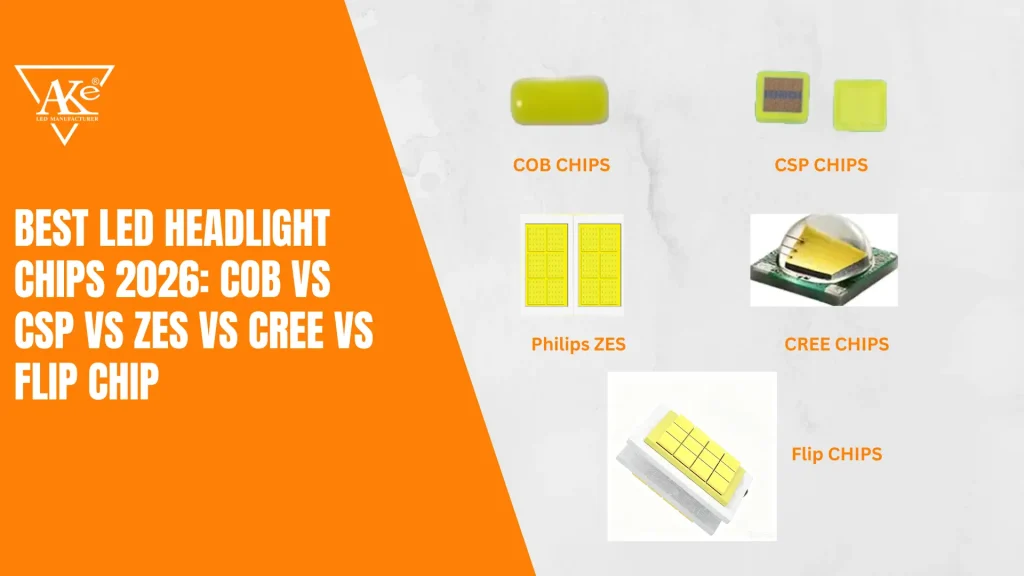
In this guide, I will compare the top 5 common automotive LED headlight chips—COB vs CSP vs ZES vs CREE vs Flip Chip—from a factory testing perspective. Compare their advantages and disadvantages, and point out which is the best choice for 2026. You’ll understand:
- Why is cheap not necessarily a good deal?
- Why are our products priced higher than those of some suppliers?
- Which LED headlight chips are the best in 2026?
If you are a B2B buyer, distributor, or simply a car owner looking to upgrade your headlights, this article can help you make an informed decision.
Quick Comparison: LED Headlight Chips
| Chip Types | COB | CSP | Philips ZES | CREE | Flip Chip |
| الحجم | Large | Small | مضغوط | Large | مضغوط |
| Brightness Potential | منخفضة | Medium-High | متوسط | High (concentrated) | Very High |
| تبديد الحرارة | Poor (glare-prone) | Good | Excellent | Very Good (narrow beam) | Excellent |
| Light Pattern | Poor (prone to glare) | Good | Excellent (best) | Good | Excellent |
| التكلفة | Lowest | Low-Medium | عالية | عالية | Medium-High |
| Best Uses | Fog lights, low-power lights | متوسط | Longer | Longer | Very Long |
| العمر الافتراضي | Shorter | Home projector lights | High-end safety modifications | Off-road high-brightness lights | High-end LED headlights for all scenarios |
| Recommendation Index (out of 10): | 5 | 7.5 | 9 | 8 | 9.5 |
Need to Know: What are LED Chips?
LED chips emit light through semiconductors and are typically measured in milliseconds (mils), such as 43mil, 55mil, and 75mil. The Larger LED chips offer higher power and brightness per chip, but actual performance depends on packaging technology, heat dissipation, and driver specifications.
Common Misconceptions:
Is a larger chip always brighter? Not entirely. Packaging, luminous efficacy, and heat dissipation also have an impact.
Is higher lumen output always better? Need to pay attention that some LED headlight supplier often exaggerate their figures; true effective brightness depends on the concentration of the light pattern.
Key point of LED chip quality: Brightness, light pattern clarity, color temperature (recommended 5000-6500K), heat dissipation, lifespan (>30,000 hours), and cost-effectiveness.
Top 5 Common LED Headlight Chips Used in Automotive Lighting
COB (Chip on Board)
What Is It?
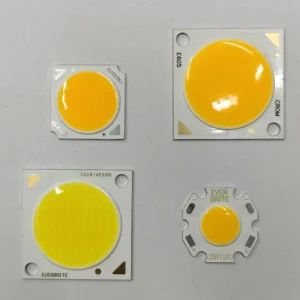
COB directly encapsulates multiple LED chips onto a substrate, forming a large-area, uniform light source. It was commonly used in early LED headlights. COB currently holds approximately 40% of the LED lighting market share, making it one of the most widely used chip types globally.
Pros of COB Chips
Cons of COB Chips
Where Is It Used?
COB chips are primarily used in auxiliary lighting applications, such as interior dome lights, license plate lights, trunk lights, and chassis lights. Some lower-priced headlight bulbs and fog lights also use COB technology, but their performance is generally mediocre.
Factory Insider’s Take
COB headlight bulbs are suitable for cost-sensitive consumers with limited budgets. However, we generally recommend against using COB chip bulbs in main headlights (especially fog lights or low beams) in mid-to-high-end product lines.
CSP Chip (Chip Scale Package)
What Is It?
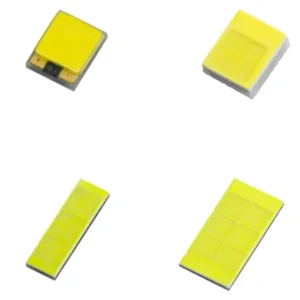
Chip Scale Package is an advanced integrated circuit packaging technology. Its core feature is that the package size is close to the size of the chip itself, and the package area is usually no more than 1.2 times the chip area.
Pros of CSP Chips
Cons of CSP Chips
Where Is It Used?
CSP is used in the mid-range LED headlight market. It‘s widely used in aftermarket LED bulbs for reflector housings and projector headlights.
Factory Insider’s Take
CSP chips represent a significant technological advancement over COB chips, but heat dissipation remains an important weakness of CSP bulbs.
If you are purchasing CSP bulbs, be sure to carefully examine the heatsink design and fan quality—these factors will determine whether your CSP bulb lasts 3 years or 3 months.
Philips ZES Chip (LUXEON Z ES)
What Is It?
The Philips ZES chip (Also Lumileds Luxeon ZES LED chip) is a high-performance LED chip developed by Lumileds.
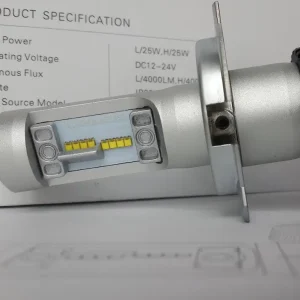
Only 1.6mm x 2.0mm, it is one of the smallest high-power lighting LED chips currently available. Unlike traditional dome LED packages, the ZES chip features a maskless design (i.e., no silicone cover on the chip surface).
Pros of Philips ZES
Cons of Philips ZES
Where Is It Used?
Philips ZES chips are the preferred choice for new high-end LED headlight bulbs, widely used in original equipment (OEM) replacement bulbs and high-end aftermarket kits.
Factory Insider’s Take
These chips are relatively expensive and suitable for high-end customers. For wholesalers, distributors, and other B2B buyers, the price will be very high.
CREE Chips
What Is It?
CREE (now Wolfspeed) is a legendary American semiconductor company. It is renowned for producing the brightest LEDs on the market.
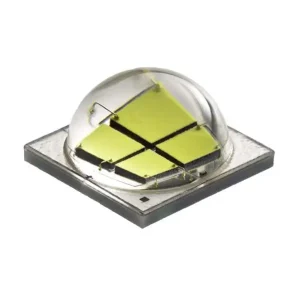
The XHP50 and XHP70 series have become benchmark products in high-performance automotive lighting applications.
Pros of CREE Chips
Cons of CREE Chips
Where Is It Used?
CREE chips are used in high-performance off-road lighting and high-beam headlights. They are not commonly found in low-beam headlights.
Factory Insider’s Take
If you’re looking for the power, don’t focus on cost; CREE chips are the choice. For driving frequently on unlit highways or rural roads, the distance from CREE-powered high beams could keep a safety difference.
Flip Chip
What Is It?
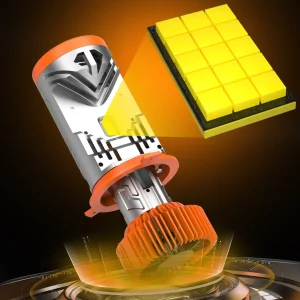
Nowadays, Flip-chip technology is the hottest trend in LED automotive lighting. Because the flip chip does not require a substrate, no solder wiring, small size, and high light density. Many new high-end LED headlights for 2025-2026 use this technology, such as AKE.
Pors of Flip Chips
Cons of Flip-Chip
Where Is It Used?
Flip-chip is becoming more and more popular preferred choice for LED headlight bulb manufacturers in 2025-2026. Well-known brands like AKE and NAOEVO have already begun shipping products using 8-chip 55mil flip-chip arrays.
Factory Insider’s Take
We have produced countless LED bulbs using various chip types, from COB to Flip Chip, and finally, we believe that Flip Chip is currently the best choice in the automotive LED bulb market. Because it perfectly balances product performance, quality, and cost, which are precisely the three key points that our B2B customers need most.
For LED automotive lighting manufacturers and suppliers of COB or mid-range CSP bulbs, Flip Chip is the best upgrade way to reduce warranty claims and increase customer satisfaction by improving the chip in the product. These two points directly affect your profits.
Why Recommend Flip Chip LED Headlight Bulbs?
It’s difficult for a product to become mainstream. Flip-chip technology is rapidly becoming mainstream nowadays. For LED automotive lighting manufacturers, it is a preferred choice. Because products manufactured using flip-chips surpass traditional chips in almost every dimension, including luminous efficacy, heat dissipation, reliability, and compatibility.
No one wants to offer higher brightness at a lower manufacturing cost.
There are three key points of flip-chip LED headlight bulbs:
- السطوع – Light extraction efficiency can be improved by 15%~30%, resulting in brighter and better illumination; typically brighter than ZES.
- التكلفة – With the maturity and localization of flip-chip technology, their cost has decreased, improving cost-effectiveness and moving them from “high-end exclusive” to “mainstream standard”.
- Heat dissipation – Flip-chips conduct heat directly to the headlight substrate through the metal solder joints on the bottom, resulting in lower thermal resistance and a 15~25°C reduction in junction temperature. This ensures longer service life.
Frequently Asked Questions About LED Chips
الخاتمة
Flip Chip will be the top choice for LED headlight chips in 2026 due to its advantages. Choosing the right LED Headlight chips can not only help you stand out in your local market but also reduce costs and increase profits.
If you wish to order Flip Chip LED Headlight Bulbs, please feel free to contact AKE for the correct quote.
 English
  Español
  Português
  العربية