
High beam and low beam are the primary headlight modes for vehicles. In darkness or insufficient light, if drivers fail to turn on their lights in time or misuse them, traffic accidents are more likely to occur. The misuse of high beams is a perilous, albeit hidden, threat to traffic safety.
According to data from the National Highway Traffic Safety Administration (NHTSA), approximately 50% of traffic accidents occur at night, while nighttime driving accounts for only 25% of total driving time. This difference is largely due to the incorrect use headlight. Proper use of high and low beams provides clear visibility in the dark while preventing danger to other road users.
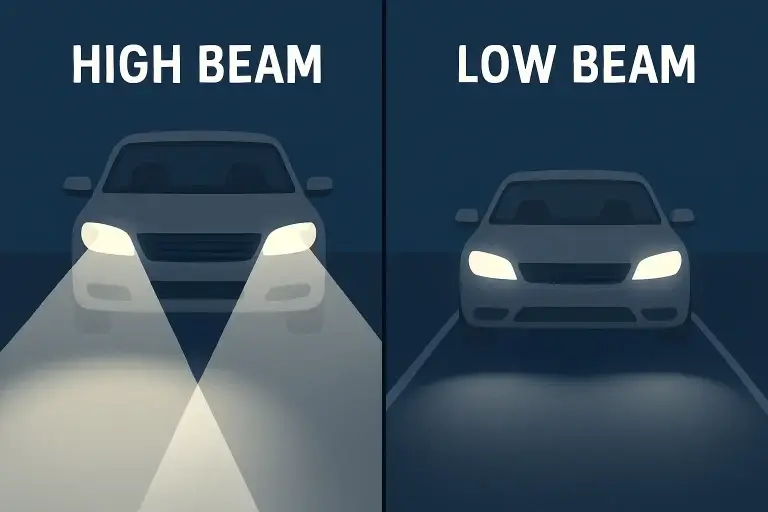
Next, I will explain the High Beam vs Low Beam differences, advantages, and appropriate times to use, as well as the benefits of upgrading to LED or HID headlights, helping you become a responsible safety enthusiast.
What are Low Beam Headlights?

Low beam headlights, also known as dipped beam headlights, are the default mode for car headlights. It is designed for short-range illumination, ideal for everyday nighttime driving.
The illumination distance is generally within 50 meters, with a wider beam width but a lower height. Their primary purpose is to clearly see the road ahead and avoid dazzling the drivers of vehicles ahead.
Many newer vehicles are equipped with automatic low-beam headlight systems. When the lighting is insufficient (e.g., at night, in tunnels, or in dimly lit environments), the automatic low-beam headlight systems will automatically activate.
Low beam headlights also utilize the latest lighting technologies currently available, such as bi-beam bulbs, LED headlights, or HID xenon lamps. Both of these technologies provide drivers with clearer vision, and certified low beam headlights prevent glare from affecting other drivers.
Moreover, Many countries have laws requiring low beam headlights to be used within half an hour after sunset, and even recommend their use in low-light conditions during the day.
What are High Beams Headlights?
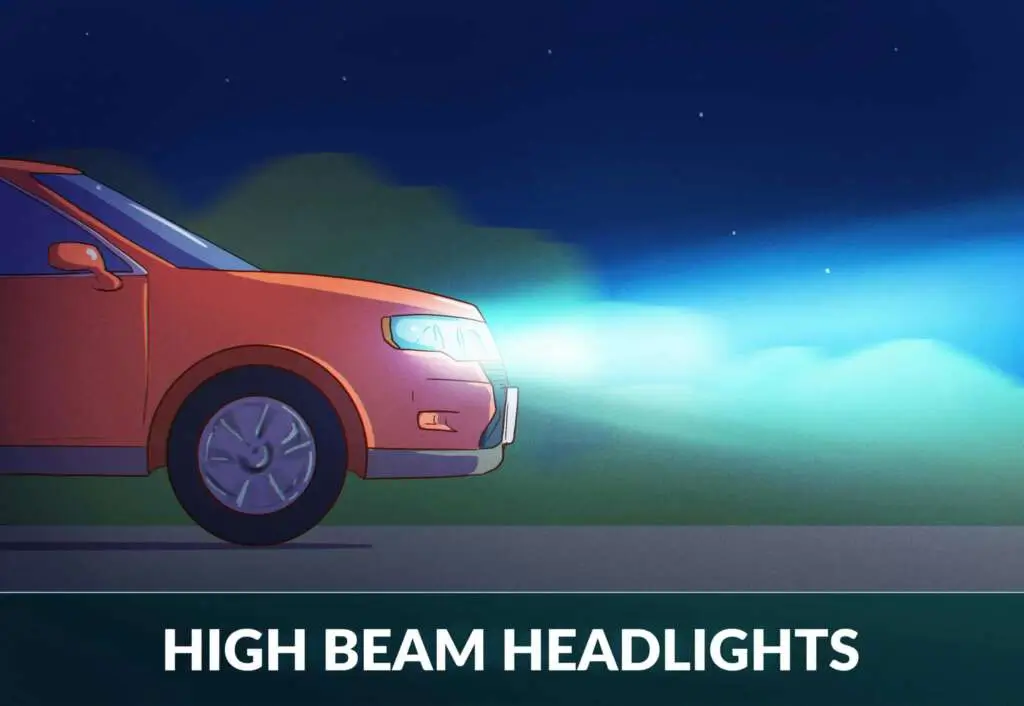
High-beam headlights, also known as high beams or main beams, are an enhanced version of headlights.
They provide a brighter, more focused beam that shines directly ahead, typically illuminating a distance of 200-300 meters (approximately 650-1000 feet) or even further. Suits for use on completely dark roads with no traffic, such as rural roads or remote sections of highways in the United States.
However, you must immediately switch off your high beams when meeting oncoming traffic. Otherwise, the intense light from high beams, if used when other vehicles are present, can severely dazzle oncoming drivers, potentially leading to accidents.
Some high-beam headlights are not properly adjusted for beam control; it will be dangerous and may result in fines in most countries.
Therefore, choosing reliable high beams is crucial for businesses such as automakers, dealers, and wholesalers.
The Basic Difference Between High Beam VS Low Beam Headlights
Even you know that the high beam and low beam headlights come from the same headlight system, but their design and function differ significantly.
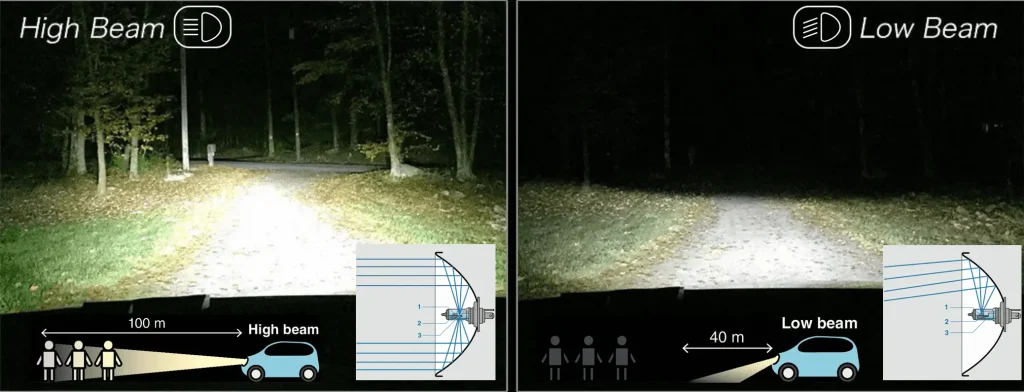
The main differences between high beam vs low beam lighting modes are:
- Illumination Distance:
High Beam: Concentrated and bright light, typically illuminating distances exceeding 100 meters. Effectively illuminates distant roads in open areas without streetlights.
Low Beam: Divergent light, shorter illumination distance, generally around 50 meters. Primarily used to illuminate the road surface near the vehicle.
- Illumination Angle:
High Beam: Higher beam angle, projecting horizontally. Illuminates higher objects, but its coverage area near the road surface is relatively narrow.
Low Beam: Lower beam angle, projecting downwards. Creates a wider illumination area in front of the vehicle, covering the road surface and nearby obstacles, pedestrians, etc.
- Brightness and Intensity:
High Beam: Significantly brighter than low beam, providing stronger illumination and suitable for use in extremely low-light conditions.
Low Beam: Relatively lower brightness, softer light, avoiding strong glare for other road users.
- Usage Scenarios:
High Beam: Suitable for dimly lit environments such as highways without streetlights, mountain roads, and suburban areas, used to expand the field of vision and detect distant hazards or obstacles in advance.
Low Beam: Suitable for urban roads, road sections with streetlights, when meeting oncoming traffic, and when crossing intersections or pedestrian crossings, providing necessary illumination without interfering with other vehicles and pedestrians.
Advantages of Low-Beam Headlights
Low beam headlights are the preferred choice for drivers in most situations, and here are their advantages:
- Reduced Glare: Because the beam is directed towards the ground, it doesn’t interfere with oncoming or following vehicles, promoting overall road safety.
- Suitable for Inclement Weather: In rain, fog, and snow, the low beam reduces glare caused by light reflections and is clearer than the high beam.
- Ideal for Urban and Traffic-Congested Areas: The wide beam illuminates the roadside, suitable for environments with streetlights or heavy traffic.
- Legal Compliance: Many areas mandate the use of low beams at certain times.
- Energy Efficiency: As the default mode, it consumes less power, extending bulb life.
- Greater Visibility: Illuminates hundreds of meters ahead, allowing for earlier detection of potential hazards such as animals or obstacles.
Advantages of High-Beam Headlights
Many aftermarket options now offer laser headlights, matrix LED headlights, etc. Laser headlights can illuminate up to 600 meters, compared to ordinary LED headlights (approximately 300 meters) or halogen headlights (approximately 30-40 meters). This provides drivers with a wider field of vision.
- Optimal for Rural and Highway Use: Provides maximum visibility on roads with little light and no other vehicles.
- Enhanced Reaction Time: Brighter light gives drivers more time to react to unexpected situations.
- Temporary Signal Use: Brief flashing can warn of hazards ahead (such as roadblocks).
Compared to the advantages of low beam headlights, the most significant advantage of high beam headlights is their ability to illuminate farther.
Legal Regulations: When High Beams Must Be Switched Off
Most countries and regions have clear regulations regarding the use of high beams. The following are generally applicable legal principles:
Situations where high beams must be switched off:
- When approaching an oncoming vehicle at approximately 300 meters (1000 feet);
- When following a vehicle within approximately 150 meters (500 feet);
- When driving in urban areas or areas with sufficient street lighting;
- In adverse weather conditions such as fog, rain, or snow;
- When there is sufficient ambient lighting on the road.
Situations where high beams are permitted:
- On rural or remote roads without streetlights;
- On open roads with no oncoming or following vehicles;
- In some countries, briefly flashing high beams is permitted as a passing signal (check local regulations).
- It may result in fines, demerit points, and legal liability in the event of an accident if you violate these regulations. For example, in California, improper use of high beams can result in a fine of up to $238.
When to Use High Beams: Best Times
When you rural roads with little traffic and no streetlights, high beams can improve visibility.
On highways with little traffic, high beams provide a longer reaction time. However, you need to pay attention to vehicles ahead and switch to low beams as they approach.
I don’t recommend you use high beams in foggy conditions. Because the air is less transparent, the light will diffuse and reflect off the fog lights, not only failing to improve visibility but also creating a blurred view and posing a significant driving hazard.
Common Mistakes and Dangerous Behaviors
1. Revenge Glare

Avoid road rage while driving. When another vehicle approaches with its headlights off, some drivers will retaliate by turning on their own high beams.
This behavior is extremely dangerous, causing temporary blindness to both parties and potentially leading to catastrophic consequences.
2. Obstructing High Beams
You may see videos online of drivers attempting to partially obstruct their high beams with tape or paint. This is a violation of traffic safety.
3. Reliance on Automatic Lighting Systems
With the widespread use of automatic lighting systems in modern cars, drivers may become overly reliant on them. However, even advanced systems can become ineffective in determining when to switch lights. Drivers must still maintain active control.
Lighting Strategies in Inclement Weather
- Driving in the Rain:
In the rain, low-beam headlights are usually the best choice. High beam headlights actually reduce visibility.
The downward beam of low beam headlights illuminates slippery surfaces better while reducing glare.
- Driving in Fog:
High beam headlights are absolutely forbidden in dense fog.
The correct approach is to use low beam headlights in conjunction with fog lights (if your car doesn’t have fog lights, I recommend retrofitting them).
Some regions require rear fog lights to be on in foggy conditions.
- Precautions in Snow:
Low beam headlights are also effective when it’s snowing. High beam headlights will create a white glare on the snowflakes in front of you.
Global Headlight Usage Regulations
- North America:
Individual provinces/states in the US and Canada have their own specific regulations, but generally require the use of low beam headlights in urban areas and when approaching other vehicles. Some states require headlights to be on during dawn and dusk.
- Europe:
EU countries generally require vehicles to have automatic headlight leveling systems. Many countries, especially in the Nordic countries, require low-beam headlights to be on all day.
- Asia:
Japan has strict glare control regulations, requiring headlight brightness to not exceed a specified limit. In China, high beam misuse is a common problem, and traffic authorities in many areas have strengthened enforcement.
- Australia:
Low beam headlights are required in urban areas and when approaching other vehicles. High beam use is more common in rural areas due to the higher risk of wildlife crossing roads.
Upgrade to LED or HID Headlights
Struggling to see the road clearly at night with halogen headlights? Don’t worry, upgrading to LED or HID headlights will completely solve the problem.
- One upgrade, three major improvements:
Increased brightness: LED/HID headlights offer significantly higher lumens than halogen bulbs, illuminating the road ahead with greater peace of mind.
Extended lifespan: Theoretically, they can last for tens of thousands of hours, virtually eliminating the hassle of replacement.
Reduced energy consumption: Lower power consumption achieves higher luminous efficacy.
- Here’s a key point:
If your car uses integrated high and low beams (such as the H4 bulbs used in many models), never buy single-beam LEDs.
Always choose bi-beam LEDs or bi-beam HID bulbs. These bulbs have intelligent light-shielding filters inside, ensuring excellent illumination when switching between high and low beams, truly achieving a “one-step solution” and avoiding repeated purchases.
- To corporate clients:
Auto parts retailers and automotive service providers, please note that providing professional headlight upgrade solutions (primarily offering high-quality LED products with accurate color temperature and no glare) is an effective way to enhance service value and attract high-end customers.
Conclusion: The Core of Safe Driving Lighting
I hope that using high and low beams correctly isn’t just about complying with the law, but reflects a driver’s respect for others and commitment to safety.
Anticipatory switching is key—don’t wait until the last minute to switch lights; consider in advance how your lights will affect others.
Technology assists, but it doesn’t replace a driver’s judgment—no matter how advanced your car’s lighting system is, your judgment as a driver is always the ultimate guarantee of safety.
Choosing the right headlights, whether high or low beams, is important for safe driving.
 English
  Español
  Português
  العربية