
Most people’s first impression of lasers comes from laser weapons in Western science fiction movies and novels. However, few know that they are already being used in the car headlights of well-known car brands like BMW and Audi.
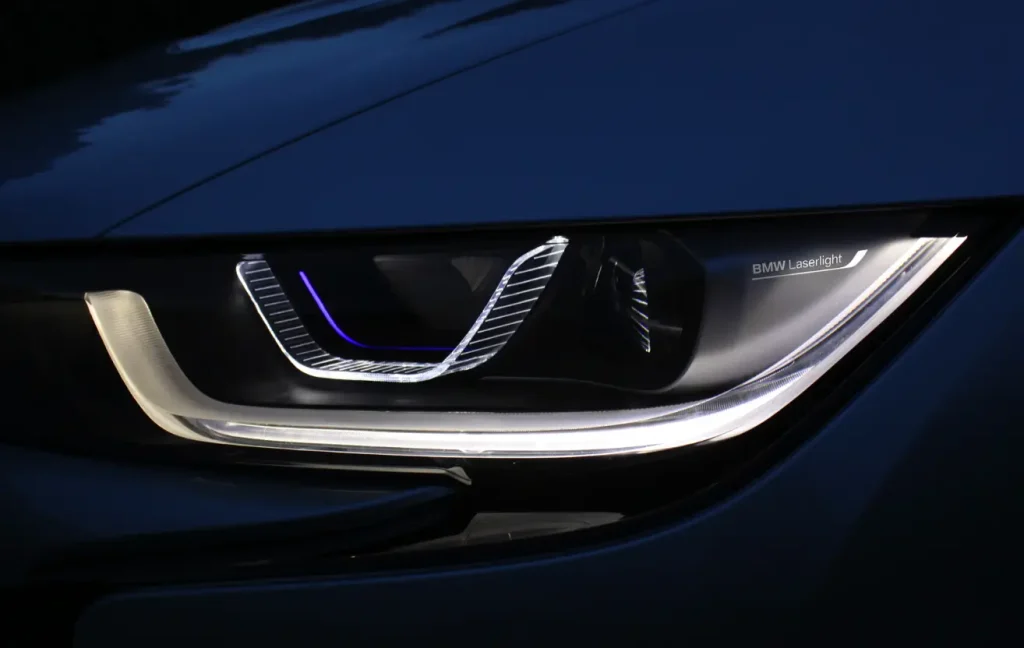
For the beginners, I believe many people have these questions. What are laser headlights? How do they work? What are their pros and cons compared to traditional halogen, xenon, or LED lights? (If you want to know more information, you can look at Halogen vs HID vs LED Headlights: Which Car Headlights are Best?)
Therefore, in this 2026 guide, I will comprehensively introduce everything you should know about laser headlights, helping you avoid being misled when buying car headlights or choosing the most suitable headlights for your needs.
What Are Laser Headlights?

Automotive laser headlights are advanced lighting systems. It uses laser diodes as its light source.
Some people might think it involves shining a laser beam onto the road (which is extremely dangerous), but it actually uses laser diodes to generate blue light. This blue light activates phosphor materials similar to LEDs, converting the blue laser light into bright white light.
History of Laser Headlights
This technology was first developed by the German company Osram and mass-produced for the first time in 2014 in the BMW i8, followed by models such as the Audi R8 LMX.
Laser headlights are primarily used to supplement high beams, increasing the illumination distance to over 600 meters, almost twice that of traditional LED headlights.
It is different from the “laser weapon” that people imagine; automotive laser headlights are completely safe. The system has multiple built-in protection mechanisms; if the headlight housing is damaged, the laser will automatically cut off the power, avoiding any risk.
How Laser Headlights Work?
As a wholesaler or a business with your own brand, if you want to let the customers know more about your product. Sometimes need to explain why the product has laser headlights?

The following four points will help customers understand the working principle of laser headlights.
- Laser Emission
The core of a laser headlight is a laser diode, which can emit blue laser light.
- Light Color Shaping
You may think the lasers we usually know are blue, so why do they appear white on car headlights?
This is due to the emitted blue laser light passing through a yellow phosphor filter or phosphor coating. Then these materials absorb the blue light energy and convert it into white light.
The color temperature is approximately 5500-6000K, close to natural sunlight, which reduces irritation to the human eye.
- Reflector Projects the Beam
Why do beams of light focus on the road? Because the converted white light enters a reflector bowl or lens system.
This system will focus the dispersed light into a concentrated beam.
Next, the projector lens will focus and direct the beam, projecting it onto the road.
- Output Lighting
The shaped beam is emitted from the front of the headlight, illuminating a distance of over 600 meters, even further than LED headlights.
Meanwhile, the high concentration of light reduces glare for oncoming vehicles and people.
My description may be a bit long, but the laser headlights’ overall working principle and entire process are highly efficient.
The laser headlights emit blue light through laser diodes, which undergo color conversion and beam shaping to ultimately output a high-brightness, long-range, low-glare white beam.
Laser Headlights Vs. Halogen, HID, And LED Headlights: A Comprehensive Comparison
| Type | Halogen Headlights | HID Headlight | LED Headlights | Laser Headlights |
| Illumination Distance | 100-150 meters | 200-300 meters | 300-400 meters | Over 600 meters |
| Energy Consumption | High | Medium | Low | Extremely low (30% lower than LED) |
| Lifespan | 500-1000 hours | 2000-3000 hours | Over 20,000 hours | Over 20,000 hours |
| Cost | Low | Medium | Medium-high | Extremely high |
| Main Disadvantages | Low brightness, high heat generation, yellowish light | Slow start-up, strong glare | High heat dissipation requirements | High cost, strict activation conditions |
Two Types Of Laser Headlights
Currently, laser headlights are widely used in automotive lighting, specifically in the form of laser bulbs and laser lenses.
1. Laser Headlight Bulbs
These resemble traditional light bulbs, have universal connectors, and contain a small lens assembly to diffuse the light beam.
Because lasers are highly focused, using them directly would only illuminate a spot the size of a fingertip. Therefore, a convex lens is needed to diffuse the light.
Even with this diffusion, the laser can only illuminate an area the size of a person’s head on a wall 10 meters away. Therefore, laser bulbs cannot directly replace low-beam or high-beam headlights.
They are currently mainly used to replace fog lights, providing brighter auxiliary lighting.
2. Laser Lenses
Laser Lenses, also known as laser headlight modules, are the actual form used in most headlights on the market today.
It doesn’t completely replace LEDs with lasers, but rather adds a laser module to the existing LED lens.
The LED is responsible for low beam and wide-angle illumination, while the laser is responsible for ultra-long-distance projection, fully utilizing the advantage of the laser’s long illumination range, making it suitable for high-speed driving scenarios.
Pros And Cons of Laser Headlights

Pros of Laser Headlights
- Longer Illumination Distance
To my knowledge, current laser headlights on the market can illuminate a range of up to 600 meters ahead, while LED headlights can only illuminate up to 300 meters.
You know, this is best for drivers in rural areas or sparsely populated regions. This design can enable them to spot obstacles, animals, or people earlier and significantly improve safety.
- Lower Energy Consumption
The laser headlights save 30% more energy than LED headlights, and they definitely help vehicles and align well with energy-saving goals. Besides, this also matches the environmentally friendly trend advocated by many consumers.
- Intelligent Adaptation
It can work in conjunction with the vehicle’s cameras, sensors, and other systems to achieve functions. Such as adaptive high beams and adaptive steering.
It can automatically avoid oncoming vehicles, prevent glare, enhance the vehicle’s nighttime perception capabilities, and provide more support for intelligent driving.
- Compact Size
A single laser diode element length is only about 10 micrometers. Which is only 1/100 of a conventional LED element.
This reduces the overall size of the headlight, allowing the designer to achieve more refined and unique shapes in automotive headlights.
- Long Lifespan
Just like LED headlights, laser headlights typically have a lifespan of tens of thousands of hours, so the driver doesn’t need to make frequent replacements and reducing maintenance costs and hassles.
Cons of Laser Headlights
- High Cost

The manufacturing cost of laser headlights is extremely high, so it will increase the cost of vehicles.
For example, the cost of laser headlights on models like the Audi A8 and BMW 7 Series can reach tens of thousands of yuan. So, because of the high cost, it is also limiting their widespread adoption.
From now on, they are mainly used in top-tier luxury vehicles.
- Regulatory Restrictions
Some countries have limited the laser headlight. In the United States, laser headlights are subject to strict regulations under Federal Motor Vehicle Safety Standard (FMVSS) 108.
And in some countries, they need to require certain conditions. Such as vehicle speed, road conditions, and ambient light, to be met before they can be turned on. So, it thus limits their actual use scenarios.
- Limited Application Scenarios
In urban roads or low-speed driving scenarios, the long-range advantage of laser headlights cannot be fully utilized, because LED headlights can reach up to 300 meters, which can already meet the daily lighting needs of all consumers.
LED Headlight vs. Laser Headlight: Which is Best?
Key Comparison
| Aspect | LED Headlights | Laser Headlights |
| Brightness | Very bright (often 3,000-6,000 lumens per side) | Significantly brighter (up to 2x intensity in high beams) |
| Range | Typically 300-400 meters for high beams | Up to 600 meters or more for high beams |
| Energy Efficiency | Excellent (low power draw, long battery life) | Slightly better in some implementations (up to 30% less energy for similar output) |
| Size | Compact | Even smaller (modules ~10x smaller than LEDs) |
| Lifespan | 30,000-50,000 hours (often outlasts the car) | Similar or longer (50,000-100,000 hours) |
| Cost | Affordable; common in mid-range cars | Very expensive (thousands extra; replacement can cost $7,000+) |
| Availability | Widespread (standard on most new cars) | High cost, regulatory limits (e.g., U.S. caps reduce advantage), mainly boost high beams |
| Best Use | Everyday driving, urban/rural roads | High-speed rural/night driving for max visibility |
| Drawbacks | Shorter range than lasers | High cost, regulatory limits (e.g., U.S. caps reduce advantage), mainly boosts high beams |
Which is Better for the Driver?
I think this question is more about whether people should choose LED headlights or laser headlights. Which is Better?
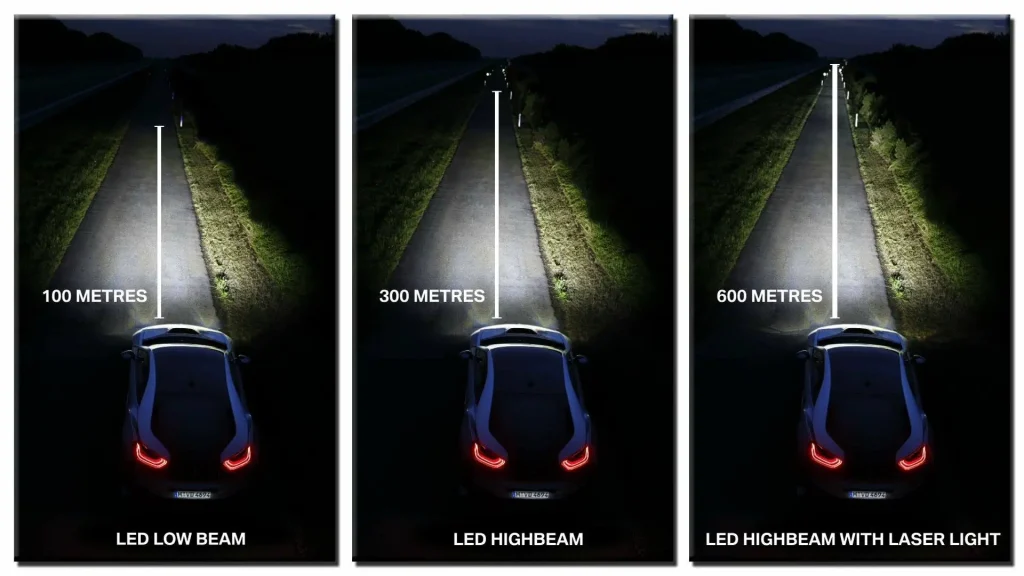
In my opinion, laser headlights are technically superior to LED headlights.
You could say it’s a pro-max version of LED headlights, with a higher beam distance and brightness that halogen, xenon, and LED headlights can’t match. This is ideal for drivers on rural roads.
However, given that LED headlights already have a 300-meter beam distance, do we really need laser headlights? This is a question many drivers ask.
My advice is that LED headlights are the best choice among basic halogen, xenon, and laser headlights—in terms of brightness, efficiency, and significantly lower price.
Currently, AKE matrix LED headlights are also narrowing the gap with laser headlights.
By the end of 2025, due to cost, advancements in LED technology, and regulatory restrictions (the US limits the brightness advantage of laser headlights), manufacturers like BMW and Audi are phasing out laser headlights in favor of more advanced LED headlights.
Which Car Models Feature Laser Headlights? (2025)
As of 2025, laser headlights will primarily appear on high-end BMW and Audi models:
BMW: X7, 4 Series Gran Coupe, iX electric SUV, etc. The 2025 4 Series/M4 will still have laser taillights, but the new 7 Series has abandoned them.
Audi: Q7, Q8, A7, etc. The R8 has been discontinued.
Other brands, such as Mercedes, have not adopted them on a large scale.
Safety and Regulations of Laser Headlights
Most people worry about the potential dangers of lasers. However, they are completely safe.
This is because lasers indirectly convert light into white light, rather than being emitted directly.
Both BMW and Audi have passed rigorous testing, and even direct eye contact will not cause eye damage.
While the US relaxed regulations in 2022, brightness limits still restrict their potential. These regulations limit headlight intensity to 150,000 candela and beam range to 250 meters (820 feet), far below the 430,000 candela allowed in Europe.
Currently, market predictions suggest that laser headlights may only be available on high-end, limited-edition models. The future mainstream will be LED matrix headlights.
Conclusion: Are Laser Headlights Worth Buying?.
Laser headlights represent the latest technology in automotive lighting. However, by 2025, matrix LEDs will be sufficient for most customer needs and will be more practical and economical.
If you are buying a model like the BMW X7 or Audi Q8, the laser option is worth considering, but for new cars, prioritizing advanced LED headlights is a wiser decision.
 English
  Español
  Português
  العربية