
When you’re upgrading or retrofitting automotive LED headlight bulbs, choosing the right projector technology is one of the most important things. Now, the most common options in the retrofit market are Bi-LED projectors and Bi-Xenon projectors.
Compared to traditional halogen bulbs, both offer superior performance.
So, which is better: Bi-LED vs Bi-Xenon projectors?
For most modern automotive lighting upgrades, Bi-LED projector lenses offer significant advantages in light efficiency, lifespan, and installation flexibility. However, for some aftermarket applications, especially those where HID systems and ballasts are installed at the time of purchase, bi-xenon projector lights remain a viable option.
This comprehensive guide compares Bi-LED vs Bi-Xenon Projectors in detail to help distributors, retrofit shops, installers, and automotive lighting buyers choose the right solution.
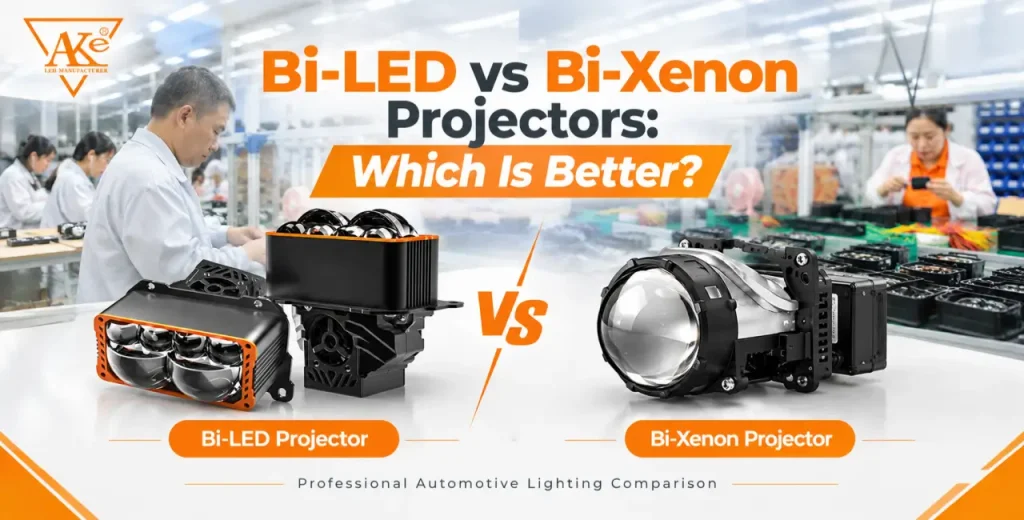
What in the World Are Bi-LED and Bi-Xenon Projectors?
All right, let’s start with bi-xenon projectors, since it was the technology that preceded the BI-LED projector.
What Is a Bi-Xenon Projector?
Bi-Xenon projector is an OEM projector that’s found in a lot of different Lexus models and Toyota applications. It was known to be one of the better Bi-Xenon projectors in its heyday.
And the question is: how does the thing work?
Bi-Xenon projectors work by having a fixed HID bulb right there in the reflector bowl that sits there in the back; it’s a D2S or D4S in this case. And that bulb does not produce any more or less light output regardless of whether you’re in low- beam or high-beam mode.
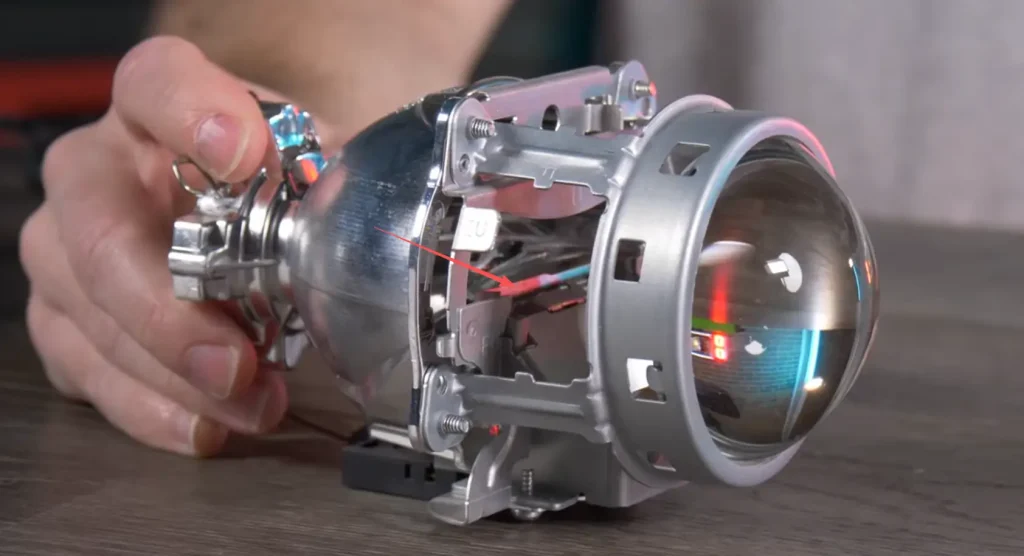
Unlike Bi-LED systems, Bi-Xenon projectors normally require additional components, including a xenon bulb, ballast, wiring, and appropriate power control.
They are particularly common in older vehicles that were originally equipped with HID lighting systems.
A typical Bi-Xenon retrofit system may include:
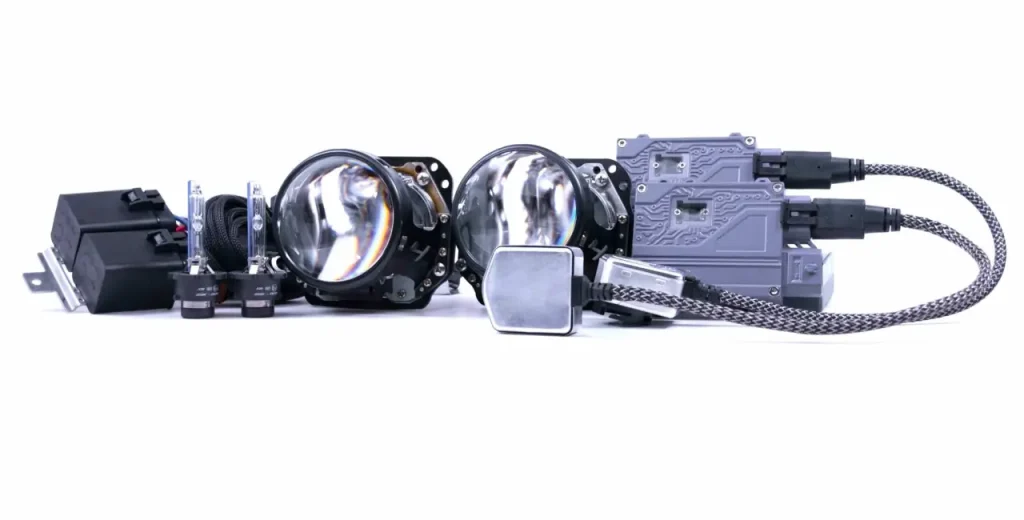
- Bi-Xenon projector lens
- Xenon HID bulb
- HID ballast
- Igniter or integrated ignition system
- Wiring harness
- Headlight housing
Because of these additional components, installation can be more complicated than installing a modern Bi-LED projector.
What Is a Bi-LED Projector?
So the same concept applies to Bi-LED projectors, which are a newer, more modern technology. Now, you no longer need to replace HID bulbs (which are prone to damage) as you used to.
Bi-LED projectors have a fixed LED chip inside the reflector bowl, but the concept for creating the high beam and low beam is still the same.
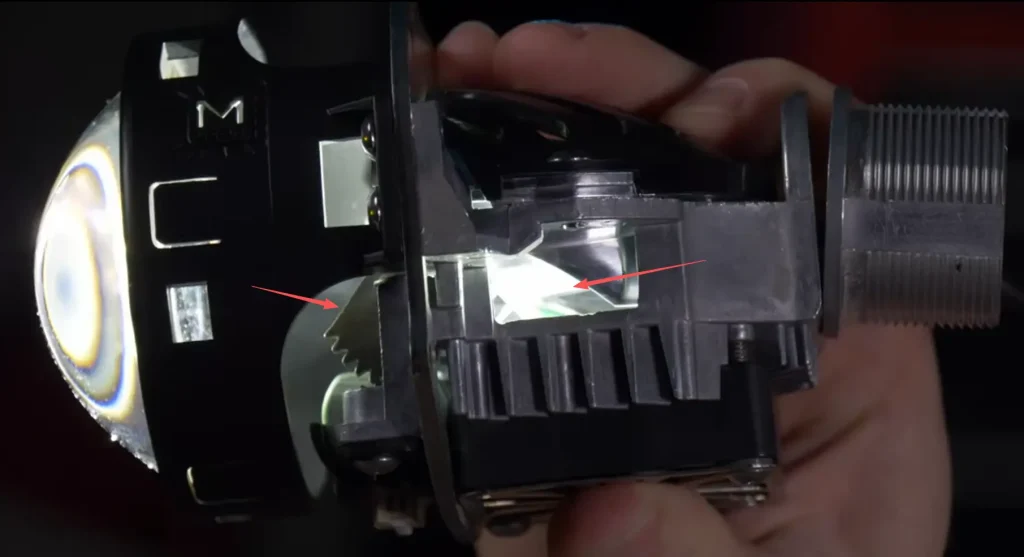
It is equipped with a movable shield that is moved by a solenoid inside the middle of the projector, which simply moves out of the way to expose more light for your high beam. The LED chip isn’t doing anything different one way or the other.
Unlike a traditional single-function projector, which typically uses two separate light sources or lenses for high beams and low beams. Bi-LED projection headlights integrate high beams and low beams into a single optical system.
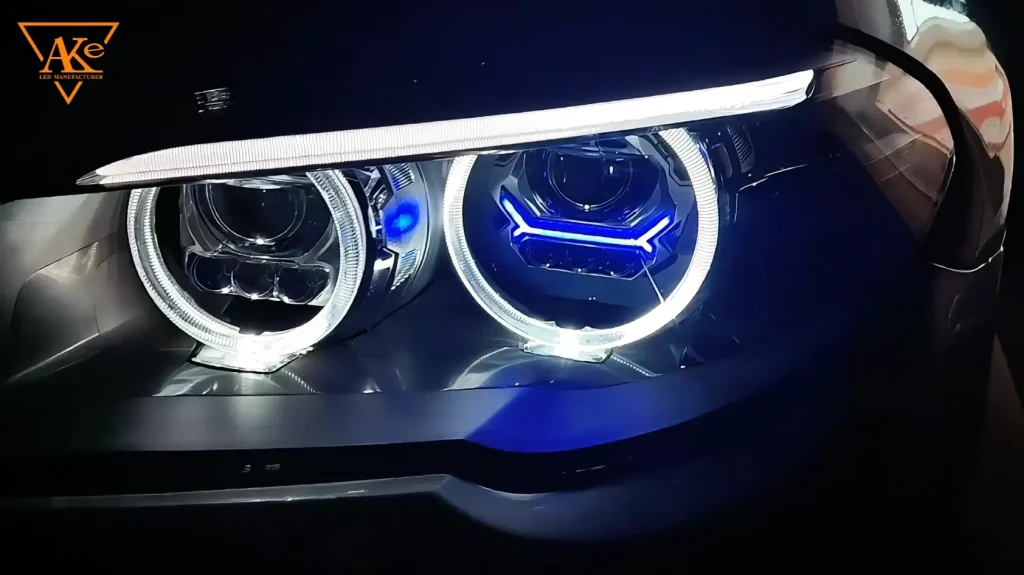
For automotive retrofit applications, Bi-LED projectors are increasingly used in:
- Headlight retrofit projects
- LED headlight upgrades
- HID-to-LED conversions
- Automotive lighting customization
- Professional retrofit workshops
- Passenger cars and SUVs
- Commercial vehicles
Bi-LED vs Bi-Xenon Projectors: Key Differences
When comparing Bi-LED vs Bi-Xenon Projectors, the most important differences come from their light sources and supporting components.
Direct Comparison List:
| الميزة | Bi-LED Projectors | Bi-Xenon Projectors (HID) |
| مصدر الضوء | الصمام الثنائي الباعث للضوء | HID Xenon |
| الضوء المنخفض | Yes | Yes |
| الضوء العالي | Yes | Yes |
| وقت الإحماء | فوري | Requires warm-up (about 2-4s) |
| السطوع | 3200–4000+ lm, wide, uniform beam pattern | 2800–3200 lm, intense hotspot, good throw |
| درجة حرارة اللون | 5000K–6000K (pure white, close to sunlight) | 4300K–5500K(White light, slightly bluish) |
| العمر الافتراضي | 20,000–50,000 Hours(Typically lasts a lifetime) | 2,000–3,000 Hours (light bulbs need to be changed regularly) |
| Power Consumption | 30–60W(higher efficiency) | Approximately 35W + ballast losses |
| Ballast Required | No | Yes |
| إدارة الحرارة | Requires good heat dissipation (fan/heatsink) | Generates significant heat, but has relatively low requirements for active cooling |
| التركيب | Relatively simple (drivers are often integrated) | Requires an external ballast, making wiring more complex. |
| Maintenance | منخفضة | Higher |
| Long-term costs | Lower (almost no replacement needed) | Higher (requires bulb replacement, possibly ballast replacement) |
| Shock resistance | ممتاز | Generally |
| Color temperature stability | Stable over the lifespan | Drifts gradually with use |
| Technology trends | Current mainstream and future direction | Mature but gradually being replaced by LEDs |
| OEM Compatibility | Increasing | Common in older HID systems |
This comparison list shows why the comparison between Bi-LED vs Bi-Xenon Projectors is becoming increasingly important as the automotive aftermarket shifts towards LED lighting technology.
1. Light Output and Beam Performance
Light output is one of the first factors considered when comparing Bi-LED vs Bi-Xenon Projectors.
Both Bi-LED and Bi-Xenon projector lamps, if properly designed, can provide powerful street lighting.

Which projector lens has better beam performance?
Modern high-quality Bi-LED projector lenses have an advantage in performance, while high-quality Bi-Xenon projector lamps can also provide excellent lighting effects.
For professional car retrofit businesses, the optical design and actual beam pattern should be tested before selecting a projector lens for large-scale installation.
2. Power Consumption and Efficiency
Bi-LED systems are more efficient because they convert more electrical energy into light energy. Bi-Xenon systems typically consume about 35 watts per side, plus ballast losses. Therefore, Bi-LED projector headlight systems offer a simpler and more energy-efficient solution.
This is particularly valuable for:
- Passenger vehicles
- Commercial fleets
- Electric vehicles
- Hybrid vehicles
- Vehicles with limited battery capacity
For buyers looking for long-term operation, when comparing Bi-LED vs Bi-Xenon Projectors, Bi-LED projector headlights are often a more attractive option.
3. Lifespan and Reliability
LED headlights are designed for long-term operation without the need to replace traditional bulbs; thus, a well-designed Bi-LED projector headlight can reduce maintenance costs.
Therefore, Bi-LED projector headlights are far superior in this respect. Their rated lifespan is 30,000 to 50,000 hours, meaning that under normal use, their lifespan may even exceed the lifespan of the vehicle.
Bi-xenon bulbs typically have a lifespan of only 2,000 to 3,000 hours. Furthermore, ballast and ignition failures can occur, increasing maintenance complexity. In contrast, Bi-LED bulbs generally require less maintenance over many years of use.
However, there is one point we cannot ignore: the lifespan of LEDs is greatly affected by thermal management. LED chips generate heat, which must be effectively dissipated from the light source.
Therefore, professional Bi-LED projectors should have an effective thermal design, which may include:
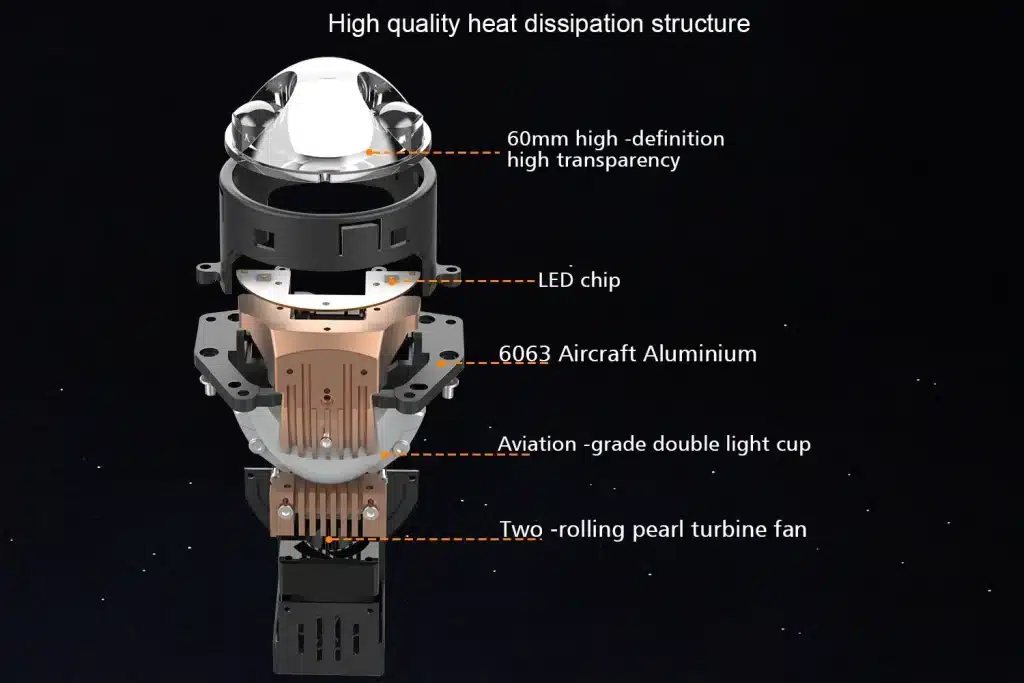
- Aluminum heat sinks
- Copper components
- Cooling fans-one or two
- Optimized heat dissipation paths
- Temperature control systems
Winner for long-term maintenance: Bi-LED
For customers seeking low-maintenance lighting solutions, Bi-LED projectors are often a better choice.
4. Startup and Response Time
One of the clearest differences between Bi-LED and Bi-Xenon projector headlights is their start-up time.
LED systems can illuminate almost instantly, while Bi-Xenon headlights require a few seconds of warm-up time. While driving, a difference of a few seconds can affect driving safety.
This difference is very important for high-beam switching.
Bi-LED projectors offer the following advantages:
- Instant start-up
- Fast high-beam response
- Stable illumination
- No HID warm-up delay
This advantage makes Bi-LED technology suitable for modern automotive lighting systems.
5. Installation Complexity
Installation is another important factor when comparing Bi-LED vs Bi-Xenon Projectors, especially for professional retrofit shops.
Bi-LED projectors typically require fewer components than Bi-Xenon projectors.
- A Bi-Xenon system may require:
Projector + xenon bulb + ballast + wiring harness + ignition assembly
- A Bi-LED system may require:
Projector + LED driver + wiring harness
The specific configuration depends on the product.
Fewer components mean a simpler installation process and fewer potential points of failure.
For modification shops with a large customer base, installation efficiency directly affects labor costs and customer satisfaction.
6. Cost: Bi-LED vs Bi-Xenon Projectors
There is one thing you need to know: the initial purchase price is not the only factor when comparing Bi-LED vs Bi-Xenon Projectors.
A Bi-Xenon system may require additional components, such as:
- HID bulbs
- Ballasts
- Wiring harnesses
- Ignition assembly
These additional components will also increase the total cost and installation workload.
In other words, the initial unit price of a Bi-LED projector lens may be higher, but for long-term use, it won’t require frequent maintenance, and the modification plan can further reduce costs.
For projector lens distributors and retrofit shops, the better question is not simply:
“Which projector is cheaper?”
Instead, consider:
“Which projector lens can provide the best total value over its service life?”
7. Considering Modern Automotive Trends
As technology advances, many cars now use electric new energy technologies, making traditional Bi-Xenon projectors unsuitable for newer models. Bi-LED technology aligns with this trend, as LEDs are already widely used in modern automotive lighting.
For retrofit businesses, this brings about an important difference:
Choose Bi-LED when:
- Upgrading halogen headlights
- Replacing outdated HID systems
- You want the most modern, reliable, and low-maintenance solution
- Looking for lower maintenance
Choose Bi-Xenon when:
- Retrofitting older HID systems
- Reusing existing HID components
- Customers specifically request xenon technology
- You are comfortable with eventual bulb replacements
- Maximum raw intensity on a tighter budget is the goal
- Compatibility with existing projector systems is important
Bi-LED vs Bi-Xenon: Which Is Better for B2B Buyers?
For B2B buyers (distributors, wholesalers, auto shops, fleet operators, importers, and automotive lighting companies), there is no absolute “better” between Bi-LED projector lenses and Bi-Xenon projector lenses.
Both types of products have clearly defined market demands and customer groups. The key point is to match the right product to the right buyer, rather than having any one person forcibly determine which is better.
| الميزة | عدسة جهاز عرض ثنائية الصمام الثنائي الباعث للضوء | Bi-Xenon Projector Lens | Explanation |
| Technology Trends | OEM and aftermarket markets continue to grow, becoming the mainstream trend. | Mature technology, long history, replacement demand still exists. | The mainstream trend leans towards LED, but Xenon still has a remaining market share. |
| Initial Purchase Costs | Higher | منخفضة | Xenon is better positioned to enter price-sensitive markets. |
| Total Cost of Ownership (TCO) | Lower | High (requires regular bulb and ballast replacement) | This point is especially important for vehicles that have been used for a long time. |
| After-sales and Warranty | Lower | عالية | Hidden costs affecting distributors and stores |
| Installation and Efficiency | Simpler | Relatively complex | Impact on the turnover efficiency of car dealerships |
| Customer Value | Higher | متوسط-مرتفع | Different customer groups have different preferences. |
| Market Positioning | Mid-to-high-end customers seeking peace of mind and long-term value | The market is primarily driven by limited budgets, older models, and replacement demand. | Key differentiators |
Here are some recommendations for different B2B buyers:
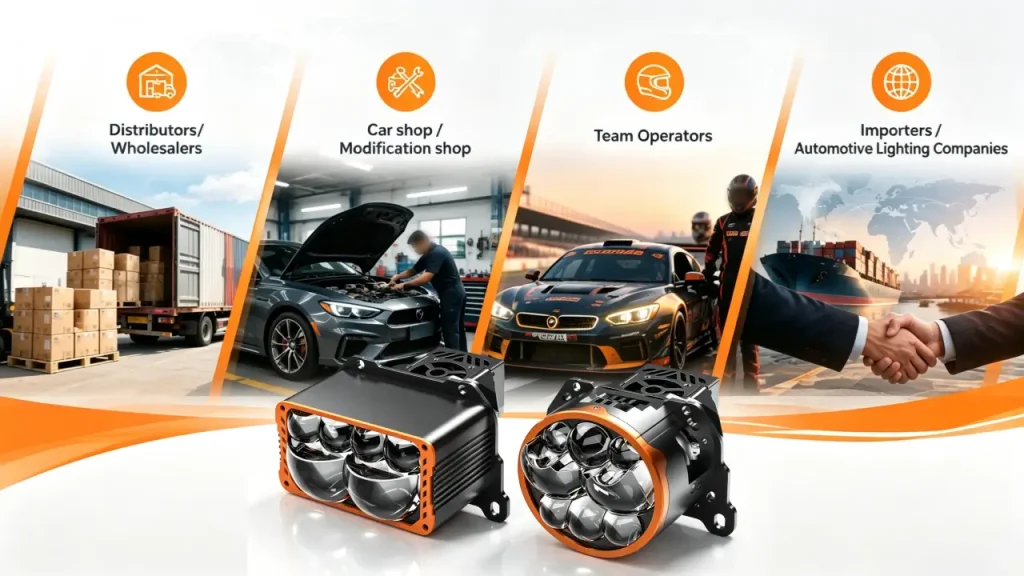
- Distributors/Wholesalers:
It’s better to choose these two products rather than focusing on one type of product.
Bi-LED projectors are currently the main driver of growth in modern car upgrades and aftermarket modifications, catering to customers seeking upgrades for the new era; Bi-Xenon projectors serve as a supplement, covering price-sensitive customers and those replacing older models.
So do not refuse to sell either type of product.
- Car shop / Modification shop
If your target customer base consists of mid-to-high-end car owners who prioritize a modern look, then Bi-LED projector headlights are a better choice.
If your target customer base primarily consists of those with limited budgets and older vehicles, then Bi-Xenon projector headlights will appeal to this demographic.
However, many established modification shops, like AKE, will stock both and will recommend projector lens headlights based on the customer’s budget and vehicle condition, rather than offering a choice between two options.
- Team Operators
In most cases, Bi-LED projectors are more suitable. They require less maintenance and are more stable, making them ideal for long-term use by teams during races.
However, if a team’s vehicles already use mostly Bi-Xenon, or if their procurement budget is extremely limited, continuing to use Bi-Xenon in the short term may remain a pragmatic choice.
- Importers / Automotive Lighting Companies
All products need to be made based on the regulations of the target export market, customer purchasing power, and the level of competition from similar products.
The high-end market tends to favor Bi-LED projector lenses; however, in markets with intense price competition or a large number of older car models, Bi-Xenon projector lenses still have significant demand.
A product diversification strategy is more likely to attract customers than a single product category.
For B2B buyers, there is no absolutely better product, only a product that is more suitable for a specific buyer market.
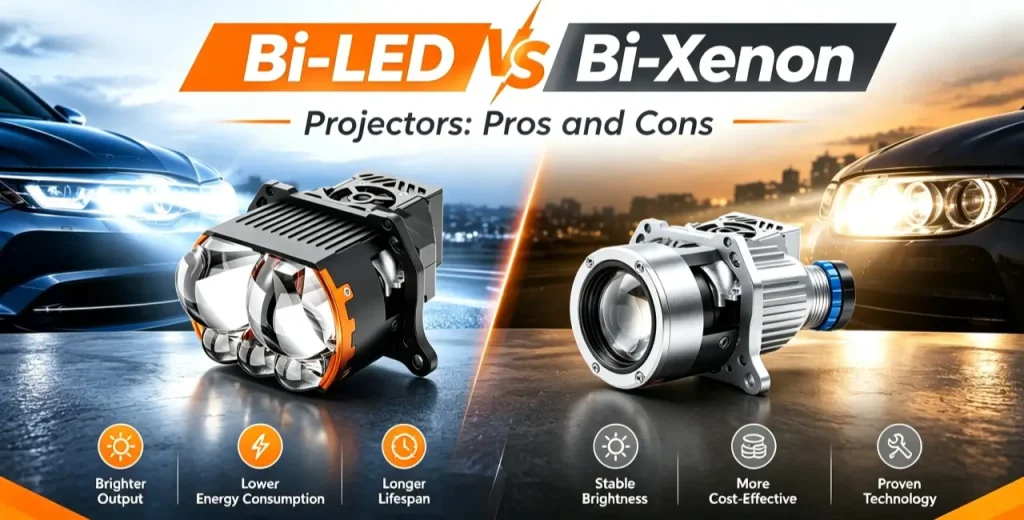
Bi-LED vs Bi-Xenon Projectors: Pros and Cons
Understanding the advantages and disadvantages can make the Bi-LED vs Bi-Xenon Projectors decision easier.
Advantages of Bi-LED Projectors
- Instant illumination
- High energy efficiency
- Long operating life
- More compact size
- Lower maintenance requirements
- No conventional bulb replacement
- Fewer supporting components
- Excellent compatibility with modern lighting systems
- Strong potential for OEM and aftermarket applications
Disadvantages of Bi-LED Projectors
- Initial purchase costs are higher.
- Need high heat dissipation; lower-priced products are easily degraded or damaged when overheating.
- The beam patterns of some low-end products are inferior to those of high-quality xenon lenses.
Advantages of Bi-Xenon Projectors
- Proven technology
- Strong retrofit market history
- Excellent performance with quality bulbs and ballasts
- Suitable for older HID-equipped vehicles
- Existing compatibility with many legacy retrofit systems
Disadvantages of Bi-Xenon Projectors
- Requires a ballast and xenon bulb
- Longer startup time; it may have problems.
- Higher maintenance requirements
- Bulbs need eventual replacement
- More installation components
- Generally less energy-efficient than modern LED systems
So, Which Is Better: Bi-LED or Bi-Xenon projectors?
After comparing Bi-LED vs Bi-Xenon Projectors, which one should you choose? In my personal experience, for most new automotive lighting upgrades, Bi-LED projector headlights are the better overall choice.
From both a product aesthetic and performance perspective, Bi-LED projector headlights are very suitable for modern automotive lighting applications.
However, if you have an older model, Bi-Xenon projector headlights would be more suitable.
Finally, the choice depends on the customer’s needs. What we can provide is a breakdown of the advantages and disadvantages of Bi-LED vs Bi-Xenon projectors, allowing customers to clearly understand the differences at a glance.
Overall Comparison
| Category | Better Choice |
| كفاءة الطاقة | Bi-LED |
| Startup Speed | Bi-LED |
| Long-Term Maintenance | Bi-LED |
| Modern Vehicle Applications | Bi-LED |
| Installation Simplicity | Bi-LED |
| Legacy HID Compatibility | Bi-Xenon |
| Existing HID Retrofit | Bi-Xenon |
| Long-Term Technology Trend | Bi-LED |
| Overall Retrofit Value | Bi-LED |
Why Choose AKE for Bi-LED Projector Solutions?
For automotive lighting distributors, retrofit workshops, and brands looking for a reliable Bi-LED projector lens factory and supplier, manufacturing capability is critical.
AKE focuses on the automotive lighting industry, providing projector lens-based lighting solutions for professional aftermarket applications.
The main projector lenses include projector lenses, Bi-LED projector lenses, Matrix LED projector lenses, and other automotive lighting products.
For B2B customers, a suitable projector lens supplier should provide more than just a projector lens.
Since AKE also has its own offline stores specializing in upgrading and modifying LED headlights for automotive lighting, we deeply understand that product quality control, technical support, customization capabilities, and production capacity are crucial for the long-term development of an automotive lighting business.
Whether you are replacing traditional HID systems, developing a new retrofit product line, or sourcing Bi-LED projector lenses for distribution, consider the AKE LED HEADLIGHT FACTORY.
Conclusion: Bi-LED vs Bi-Xenon Projectors
The competition between Bi-LED vs Bi-Xenon projectors reflects the automotive lighting industry’s shift from traditional HID technology to LED.
Nowadays, Bi-Xenon projectors have a long history in OEMs and the aftermarket, allowing older model cars and current HID retrofit systems to continue to evolve and thrive.
However, Bi-LED offers a new upgrade option for the aftermarket. Bi-LED projectors offer advantages over Bi-Xenon projectors, such as a longer lifespan, easier installation, and instant start-up, which are preferred by automotive lighting dealers, aftermarket shops, and brands.
If you are building a new automotive lighting product line or upgrading from traditional HID technology, Bi-LED projectors are generally a better long-term choice.
Frequently Asked Questions About Bi-LED vs Bi-Xenon Projectors
Is Bi-LED better than Bi-Xenon?
For most modern car retrofits, Bi-LED projectors offer advantages in energy efficiency, startup speed, maintenance, and long-term usability. However, Bi-Xenon remains useful for older HID-equipped vehicles and specific retrofit requirements.
Are Bi-LED projectors brighter than Bi-Xenon?
A high-quality Bi-LED projector can provide excellent light output and beam performance. However, brightness depends on the projector’s optical design, LED chip, thermal management, and other components. Technology alone does not determine final beam performance.
Do Bi-LED projectors need a ballast?
Bi-LED projectors do not require a traditional HID ballast. They normally use an LED driver or integrated electronic control system.
Can I replace Bi-Xenon projectors with Bi-LED projectors?
In many retrofit applications, a Bi-Xenon projector can be replaced with a Bi-LED projector, but compatibility must be checked carefully. Projector dimensions, mounting points, wiring, headlight housing space, beam alignment, and electrical requirements should all be evaluated before installation.
Are Bi-LED projectors worth it?
For many modern retrofit applications, yes. Their combination of efficient operation, instant illumination, low maintenance, and modern lighting technology makes them an attractive upgrade for both installers and vehicle owners.
